Entropy-Engineered Multi-Metallic MOFs Unlock High-Performance Ammonium-Ion Storage

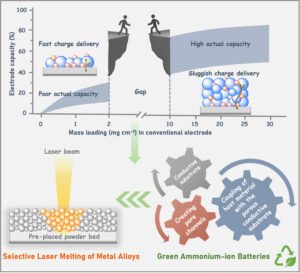
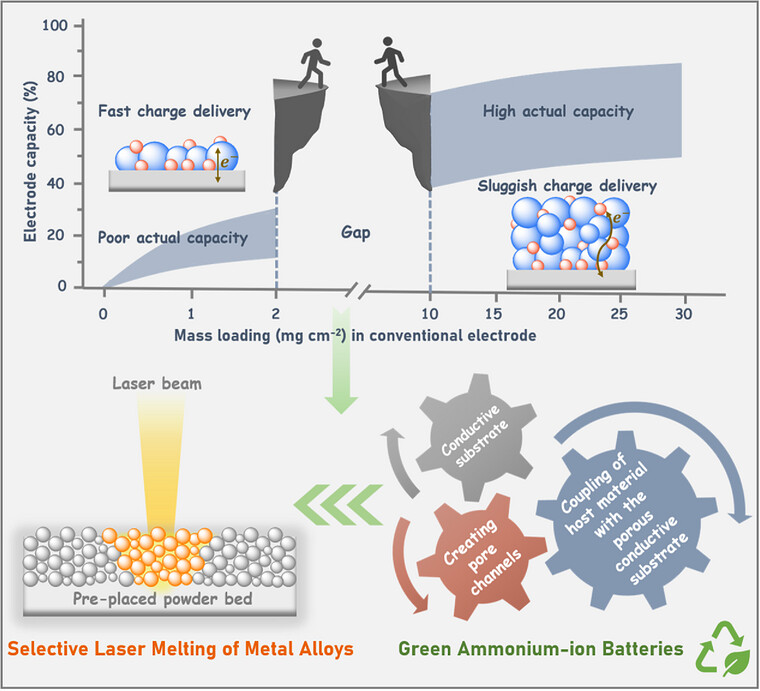
Aqueous ammonium-ion (NH4+) batteries (AAIBs) have recently emerged as promising alternatives for next-generation energy storage, owing to the unique hydrogen-bond-assisted diffusion of NH4+ ions within the host lattice framework. However, research on electrode materials remains limited, and a considerable gap persists between laboratory scale and practical applications due to the low mass loadings (1–5 mg cm−2) of conventional electrodes. This work introduces an ultrahigh mass-loading integrated 3D-printed porous conductive electrode of functional metal tellurides, Bi2-xSbxTe3 (0 ≤ x ≤ 1.5) as an efficient anode for AAIBs. To address the limited ion diffusion associated with ultrahigh mass-loading electrodes, Bi2-xSbxTe3 is integrated with a 3D-printed porous titanium alloy (Ti6Al4V) substrate fabricated via the Selective Laser Melting (SLM) technique. Such an interconnected porous framework provides efficient mass-transport pathways even at very high mass-loading levels. The designed 3D-printed Bi2Te3 anode with a mass loading of 40 mg cm−2 achieves an impressive areal capacity of 9 mAh cm−2 at 2 mA cm−2, while still retaining an exceptional specific capacity of 224 mAh g−1. To improve the cyclic stability, smaller Sb3+ ions are incorporated into the Bi2Te3 lattice to strengthen the M─Te (M═Bi/Sb) bonds, which consequently mitigates volume fluctuations during cycling. Overall, this study demonstrates the potential of 3D-printed Bi2-xSbxTe3 anodes for advancing AAIB technology.
Entropy-Engineered Multi-Metallic MOFs Unlock High-Performance Ammonium-Ion Storage

Transition metal dichalcogenide-based materials for rechargeable aluminum-ion batteries: A mini-review

Copper 3D-Printed Electrodes for Ammonia Electrosynthesis via Nitrate Reduction