Keyword Author: layered compounds

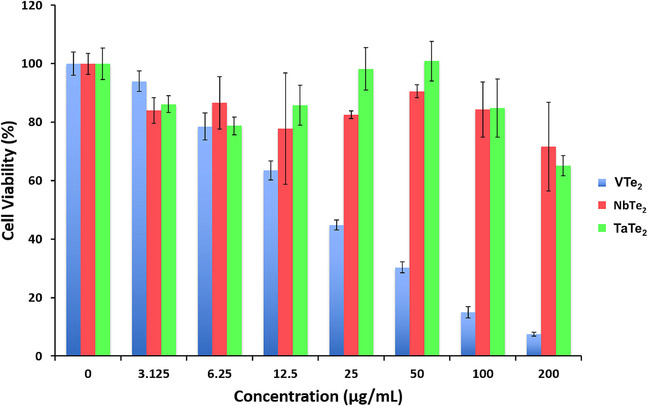
Cytotoxicity of Group 5 Transition Metal Ditellurides (MTe2; M=V, Nb, Ta)

Much research effort has been put in to study layered compounds with transition metal dichalcogenides (TMDs) being one of the most studied compounds. Due to their extraordinary properties such as excellent electrochemical properties, tuneable band gaps, and low shear resistance due to weak van der Waals interactions between layers, TMDs have been found to have …

Cytotoxicity of Group 5 Transition Metal Ditellurides (MTe2; M=V, Nb, Ta) Read More »
Universal Method for Large-Scale Synthesis of Layered Transition Metal Dichalcogenides

The layered transition metal dichalcogenides are currently amongst the most intensively investigated materials. These compounds constitute a broad family of materials, with characteristic layered structures, covering both semiconductors and metallic materials. The great attention arises from the possibility to exfoliate these materials down to single layers with many unique properties, such as thickness dependent band-gap …

Universal Method for Large-Scale Synthesis of Layered Transition Metal Dichalcogenides Read More »

Cytotoxicity of Exfoliated Layered Vanadium Dichalcogenides

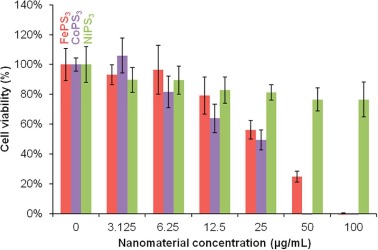
Transition-metal Group 5 vanadium dichalcogenides have shown promising properties for many applications, such as batteries, capacitors, electrocatalysts for hydrogen production and many more. However, their toxicological effects have not yet been well understood. Here, we studied the cytotoxicity of exfoliated VS2, VSe2 and VTe2 by incubating various concentrations of the materials with human lung carcinoma …

Cytotoxicity of Exfoliated Layered Vanadium Dichalcogenides Read More »

Layered Post-Transition-Metal Dichalcogenides (X-M-M-X) and Their Properties

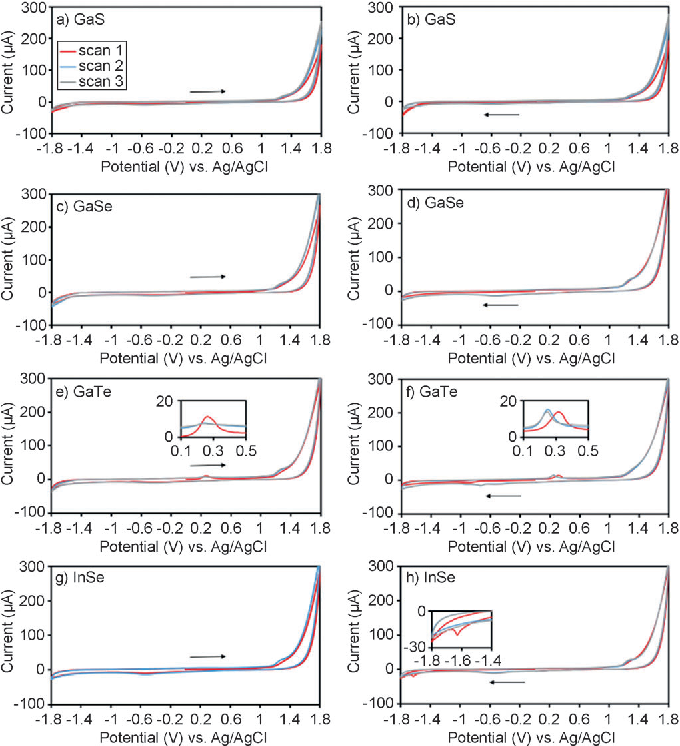
A(III)B(VI) chalcogenides are an interesting group of layered semiconductors with several attractive properties, such as tunable band gaps and the formation of solid solutions. Unlike the typically sandwiched structure of transitionmetal dichalcogenides, A(III)B(VI) layered chalcogenides with hexagonal symmetry are stacked through the X-M-M-X motif, in which M is gallium and indium, and X is sulfur, …

Layered Post-Transition-Metal Dichalcogenides (X-M-M-X) and Their Properties Read More »

MoS2/WS2-Graphene Composites through Thermal Decomposition of Tetrathiomolybdate/Tetrathiotungstate for Proton/Oxygen Electroreduction

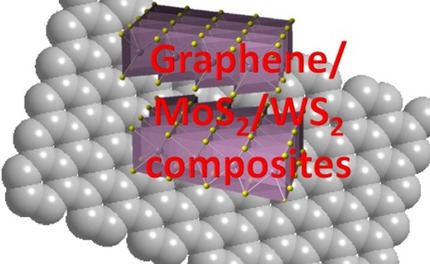
MoS2 and WS2 have been prepared on a conductive graphene support by thermal reduction of tetrathiotungstate/tetrathiomolybdate and graphite oxide. Whereas the catalytic properties towards hydrogen evolution are strongly influenced by the Magneli phases formed as a byproduct during the synthesis, the catalytic activity towards oxygen reduction of these composite materials is not affected by this …

MoS2/WS2-Graphene Composites through Thermal Decomposition of Tetrathiomolybdate/Tetrathiotungstate for Proton/Oxygen Electroreduction Read More »

Graphene-Amorphous Transition-Metal Chalcogenide (MoSx, WSx) Composites as Highly Efficient Hybrid Electrocatalysts for the Hydrogen Evolution Reaction

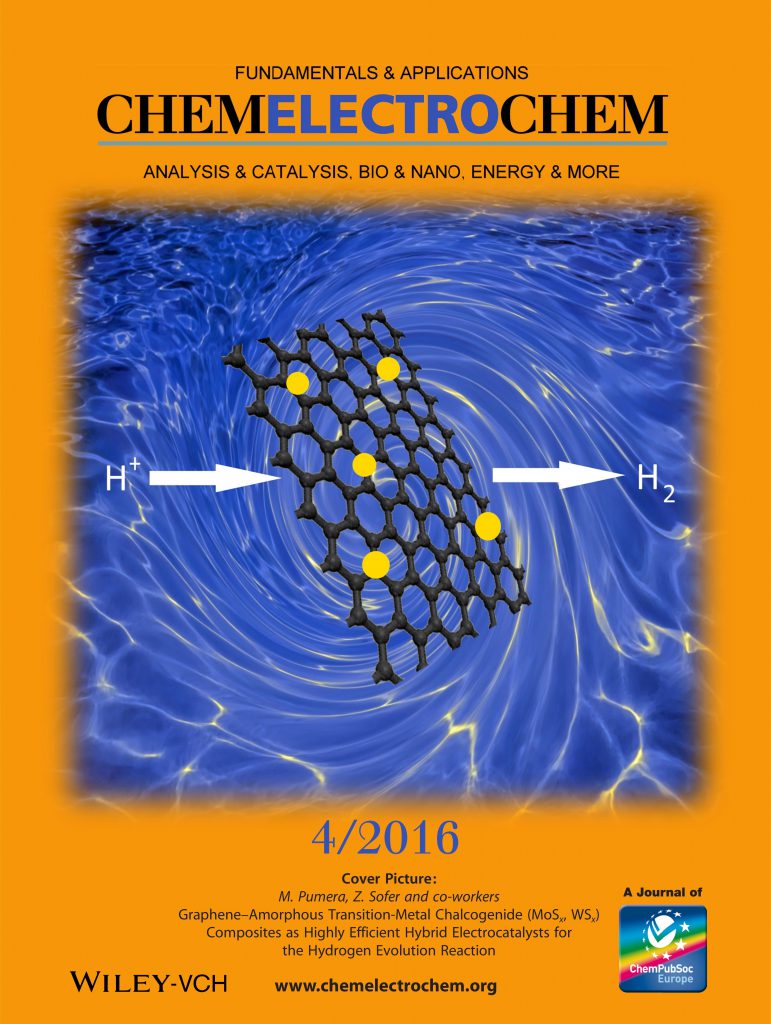
Layered transition-metal dichalcogenides (TMDs) show promising electrocatalytic properties towards the hydrogen evolution reaction (HER). A series of graphene-amorphous TMD composites were prepared under hydrothermal conditions. Materials with varying contents of MoSx and WSx were synthesized from ammonium tetrathiomolybdate and ammonium tetrathiotungstate precursors in the presence of graphene oxide and diethylene glycol as a reducing agent. …

Graphene-Amorphous Transition-Metal Chalcogenide (MoSx, WSx) Composites as Highly Efficient Hybrid Electrocatalysts for the Hydrogen Evolution Reaction Read More »

Electrochemistry of Layered Graphitic Carbon Nitride Synthesised from Various Precursors: Searching for Catalytic Effects

Graphitic carbon nitride (g-C3N4), synthesised by pyrolysis of different precursors (dicyandiamide, melamine and urea) under varying reaction conditions (air and nitrogen gas) is subjected to electrochemical studies for the elucidation of the inherent catalytic efficiency of the pristine material. Contrary to popular belief, pristine g-C3N4 shows negligible, if any, enhancement in its electrochemical behaviour in …

Electrochemistry of Layered Graphitic Carbon Nitride Synthesised from Various Precursors: Searching for Catalytic Effects Read More »

Effect of Electrolyte pH on the Inherent Electrochemistry of Layered Transition-Metal Dichalcogenides (MoS2, MoSe2, WS2, WSe2)

We set forth to investigate the changes in the inherent oxidative peaks of different transition-metal dichalcogenides (TMDs), namely MoS2, MoSe2, WS2, and WSe2, at different electrolyte pH values. Changing the pH of the electrolyte was found to influence and affect the inherent oxidation of TMDs, more noticeably the peak position. This could be attributed to …

Effect of Electrolyte pH on the Inherent Electrochemistry of Layered Transition-Metal Dichalcogenides (MoS2, MoSe2, WS2, WSe2) Read More »

Pristine Basal-and Edge-Plane-Oriented Molybdenite MoS2 Exhibiting Highly Anisotropic Properties

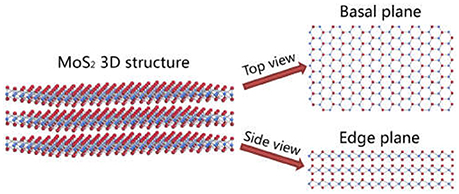
The layered structure of molybdenum disulfide (MoS2) is structurally similar to that of graphite, with individual sheets strongly covalently bonded within but held together through weak van der Waals interactions. This results in two distinct surfaces of MoS2: basal and edge planes. The edge plane was theoretically predicted to be more electroactive than the basal …

Pristine Basal-and Edge-Plane-Oriented Molybdenite MoS2 Exhibiting Highly Anisotropic Properties Read More »

Misfit-Layered Bi1.85Sr2Co1.85O7.7-delta for the Hydrogen Evolution Reaction: Beyond van der Waals Heterostructures

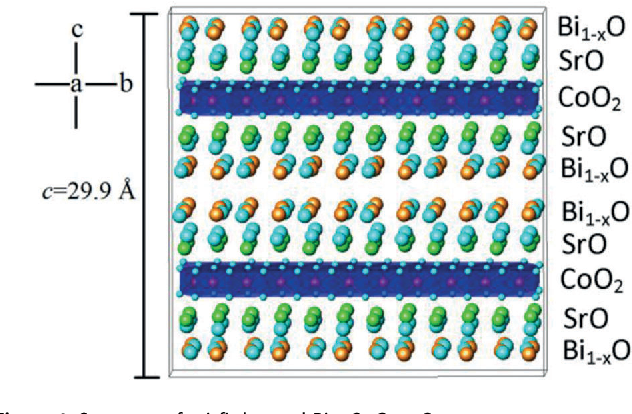
Recent research on stable 2D nanomaterials has led to the discovery of new materials for energy-conversion and energy-storage applications. A class of layered heterostructures known as misfit-layered chalcogenides consists of well-defined atomic layers and has previously been applied as thermoelectric materials for use as high-temperature thermoelectric batteries. The performance of such misfit-layered chalcogenides in electrochemical …

Misfit-Layered Bi1.85Sr2Co1.85O7.7-delta for the Hydrogen Evolution Reaction: Beyond van der Waals Heterostructures Read More »

Inherent Electrochemistry of Layered Post-Transition Metal Halides: The Unexpected Effect of Potential Cycling of PbI2

The development of two-dimensional nanomaterials has expedited the growth of advanced technological applications. PbI2 is a layered inorganic solid with important and unique properties suitable for applications in the detection of electromagnetic radiation. While the optical and electrical properties of layered PbI2 have been generally established, its electrochemistry has remained largely unexplored. In this work, …

Inherent Electrochemistry of Layered Post-Transition Metal Halides: The Unexpected Effect of Potential Cycling of PbI2 Read More »