Keyword Author: nanotubes

Graphene Sheet Orientation of Parent Material Exhibits Dramatic Influence on Graphene Properties

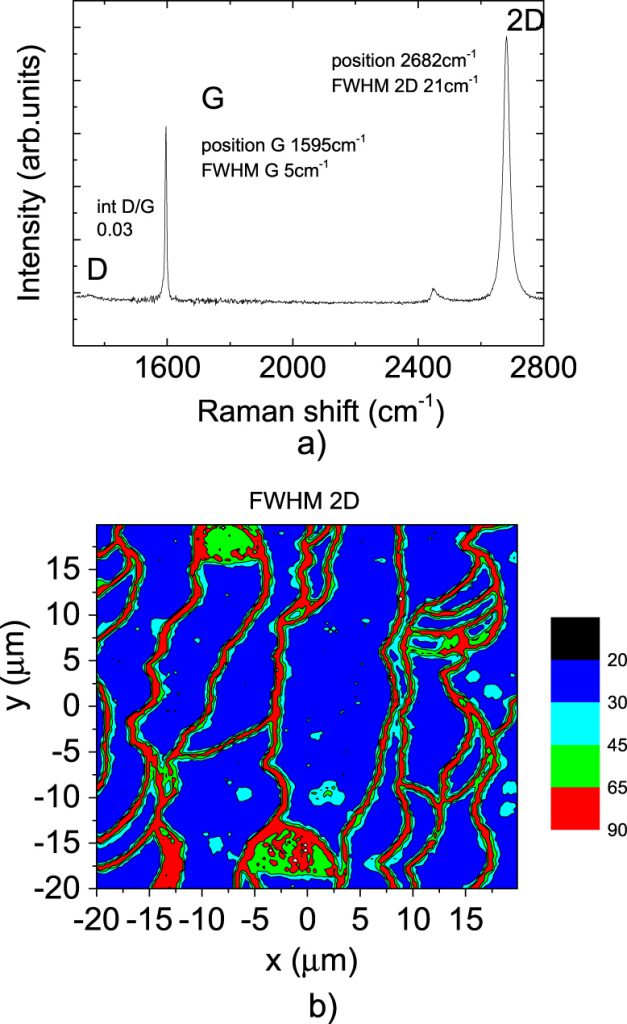
The production of graphene from various sources has garnered much attention in recent years with the development of methods that range from bottom-up to top-down approaches. The top-down approach often requires thermal treatment to obtain a few-layered and lowly oxygenated graphene sheets. Herein, we demonstrate the production of graphene through oxidation and thermal-reduction/exfoliation of two …

Graphene Sheet Orientation of Parent Material Exhibits Dramatic Influence on Graphene Properties Read More »

Bioavailability of Metallic Impurities in Carbon Nanotubes Is Greatly Enhanced by Ultrasonication

Metallic impurities within carbon nanotubes (CNTs) are considered as the main cause of their toxicity. Ultrasonication is a common procedure used to purify and obtain homogeneous dispersions of CNTs as well as to mix them with other components for further processing into composites. Herein, the influence of ultrasonication upon the bioavailability of metallic impurities in …

Bioavailability of Metallic Impurities in Carbon Nanotubes Is Greatly Enhanced by Ultrasonication Read More »

Redox-Active Nickel in Carbon Nanotubes and Its Direct Determination

The presence of residual metal-catalyst impurities in carbon nanotubes is responsible for their toxicity. It is important to differentiate between the total amount of impurities and the redox-active (bioavailable) amount of such impurities because only the bioavailable impurities exhibit toxic effects. Herein, we report a simple and specific method for quantifying the amount of redox-active …

Redox-Active Nickel in Carbon Nanotubes and Its Direct Determination Read More »

Voltammetry of carbon nanotubes and graphenes: excitement, disappointment, and reality

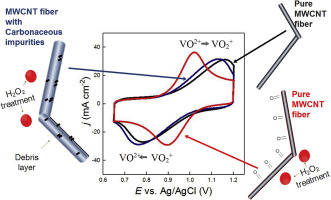
Voltammetry of carbon nanotubes and graphene underwent significant development in the first decade of the 21st century. The initial excitement concerning the performance of the new materials was replaced with increasing crises in the field caused by the use of impure materials. Here, I provide a personal view of these developments and some reality checks …

Voltammetry of carbon nanotubes and graphenes: excitement, disappointment, and reality Read More »

Nanotoxicology: The Molecular Science Point of View

Research on nanotoxicity is of extremely high scientific, social, and economic value. As nanomaterial-based products enter the market, there is an urgent need for related research in order to prevent dramatic consequences of any health-oriented issues caused by nanotechnology-driven products. The results of research on nanotoxicity have profound significance because the design of nanomaterials used …

Nanotoxicology: The Molecular Science Point of View Read More »

Direct Determination of Bioavailable Molybdenum in Carbon Nanotubes

Bioavailable residual metallic impurities within carbon nanotubes (CNTs) are responsible for the toxicity of CNTs. Herein we present a method for fast, sensitive determination of bioavailable molybdenum residual catalyst impurities within CNTs by using electrochemical oxidation in neutral pH buffers at low potentials. This method is unique because no other method can rapidly distinguish between …

Direct Determination of Bioavailable Molybdenum in Carbon Nanotubes Read More »

Regulatory Peptides Are Susceptible to Oxidation by Metallic Impurities within Carbon Nanotubes

In this article, we show that the redox properties of the regulatory peptide L-glutathione are affected by the presence of nickel oxide impurities within single-walled carbon nanotubes (SWCNTs). Glutathione is a powerful antioxidant that protects cells from oxidative stress by removing free radicals and peroxides. We show that the L-cysteine moiety in L-glutathione is responsible …

Regulatory Peptides Are Susceptible to Oxidation by Metallic Impurities within Carbon Nanotubes Read More »

Ultrathin Organically Modified Silica Layer Coated Carbon Nanotubes: Fabrication, Characterization and Electrical Insulating Properties

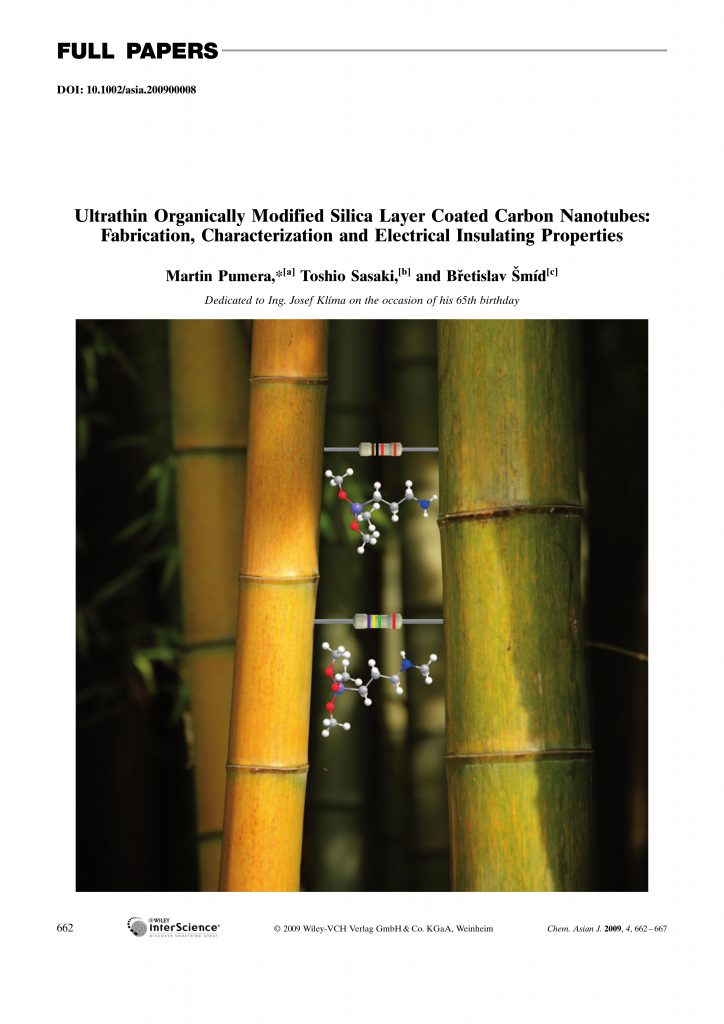
This paper describes the use of organically modified silica (ormosil) for the Ultrathin nanoprecise coating of individual multiwall carbon nanotubes using a soft-chemistry approach. Hybrid organic/inorganic ormosil nano-coated carbon nanotubes were Successfully prepared by in-situ deposition of 3-aminopropyltrimethoxysilane or N-methylaminopropyltrimethoxysilane in an aqueous suspension by means of their electrostatic interactions with carboxylic group functionalized multiwall …

Ultrathin Organically Modified Silica Layer Coated Carbon Nanotubes: Fabrication, Characterization and Electrical Insulating Properties Read More »

Metallic Impurities within Residual Catalyst Metallic Nanoparticles Are in Some Cases Responsible for “Electrocatalytic” Effect of Carbon Nanotubes

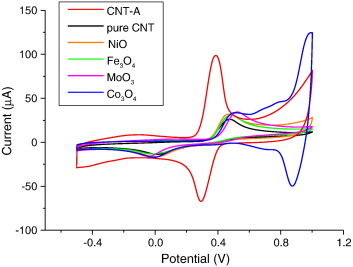
We show that in some cases, the metallic impurities within residual catalyst metallic nanoparticle impurities, which remain in carbon nanotubes from their synthesis even after purification, are responsible for “electrocatalytic” properties of carbon nanotubes. Ibis is demonstrated in an example of double-walled carbon nanotubes (DWCNTs) containing cobalt residual catalyst nanoparticle impurities, which themselves contain iron-based …

Metallic Impurities within Residual Catalyst Metallic Nanoparticles Are in Some Cases Responsible for “Electrocatalytic” Effect of Carbon Nanotubes Read More »

Spontaneous coating of carbon nanotubes with an ultrathin polypyrrole layer

A novel protocol for precisely coating individual multiwall carbon nanotubes (MWCNTs) with an ultrathin layer of polypyrrole was developed. The nanocoated MWCNTs were successfully prepared by in situ chemical deposition of polypyrrole in an aqueous suspension of MWCNTs. The coating layer was very uniform and the thickness of the layer was determined by controlling the …

Spontaneous coating of carbon nanotubes with an ultrathin polypyrrole layer Read More »