Keyword Author: impurities

Single atom engineered materials for sensors

The pursuit of high-performance sensors necessitates the exploration of new materials to realize this potential. Single atom engineering (SAE) is used to plant individual atoms into the appropriate surrounding of (nano)materials in order to confer distinct materials properties. Hence, the nano architectonics principle utilized for single atom engineering allows us to build highly specific, selective, …
Single atom engineered materials for sensors Read More »

One-Step Synthesis of B/N Co-doped Graphene as Highly Efficient Electrocatalyst for the Oxygen Reduction Reaction: Synergistic Effect of Impurities

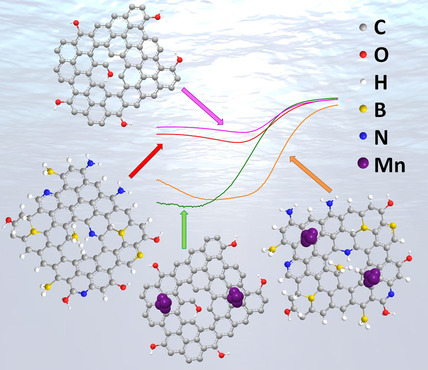
In the last decade, numerous studies of graphene doping by various metal and nonmetal elements have been done in order to obtain tailored properties, such as non-zero band gap, electrocatalytic activity, or controlled optical properties. From nonmetal elements, boron and nitrogen were the most studied dopants. Recently, it has been shown that in some cases …

One-Step Synthesis of B/N Co-doped Graphene as Highly Efficient Electrocatalyst for the Oxygen Reduction Reaction: Synergistic Effect of Impurities Read More »

Ultrapure Molybdenum Disulfide Shows Enhanced Catalysis for Hydrogen Evolution over Impurities-Doped Counterpart

The development of electrocatalysts to meet the requirements of renewable energy applications has seen much attention placed on transition-metal dichalcogenide (TMD) materials owing to their promising properties. In particular, the strategy of atomic doping has garnered some success in tuning the electronic properties and harnessing the vast potential that TMDs can offer in the catalysis …

Ultrapure Molybdenum Disulfide Shows Enhanced Catalysis for Hydrogen Evolution over Impurities-Doped Counterpart Read More »

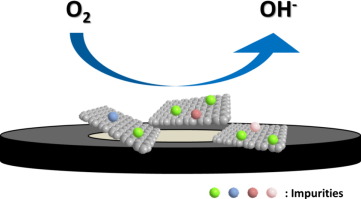
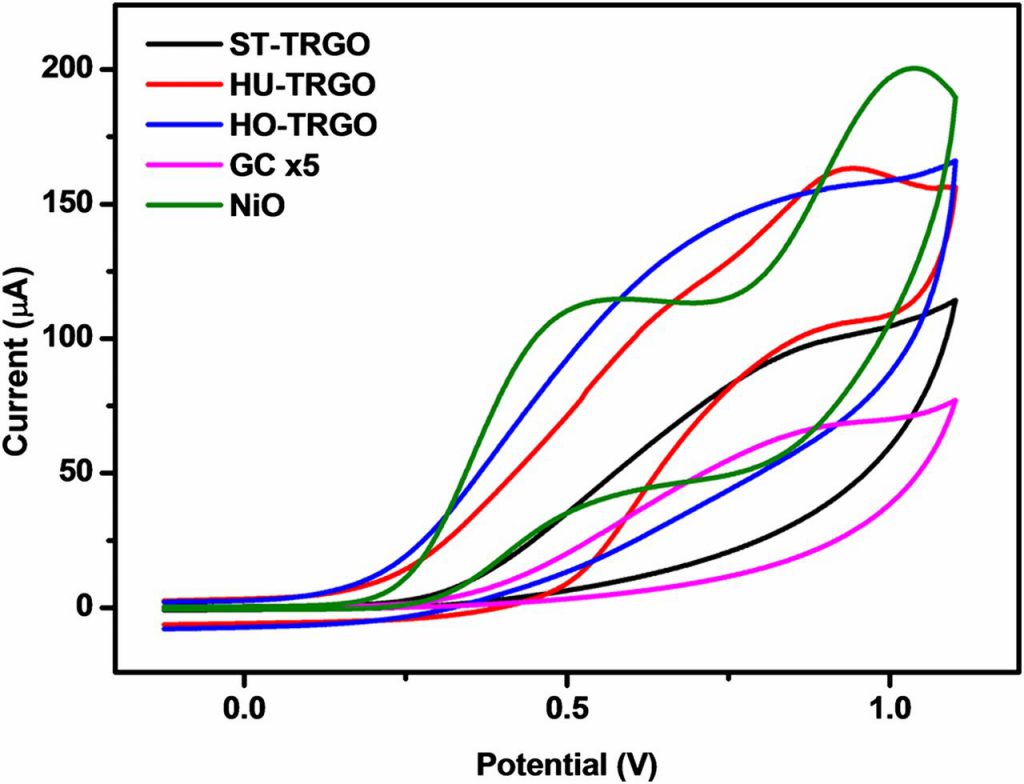
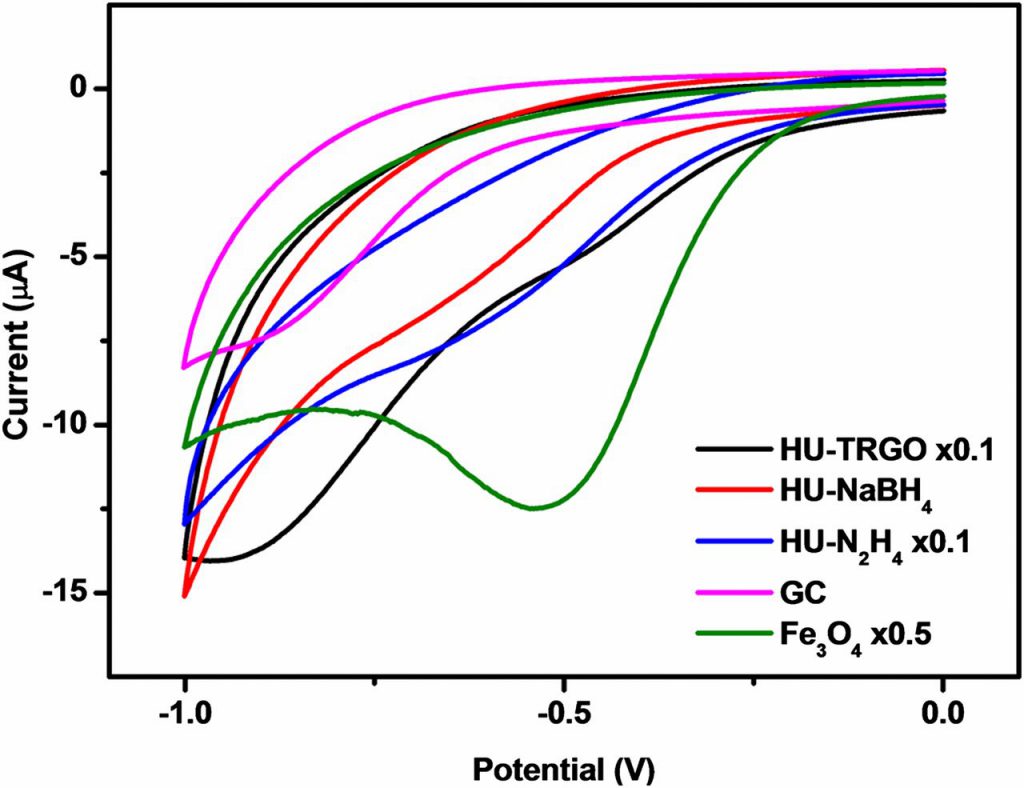
Remarkable electrochemical properties of electrochemically reduced graphene oxide towards oxygen reduction reaction are caused by residual metal-based impurities

Oxygen reduction reaction (ORR) is one of the most important electrochemical reactions in the field of energy storage. Remarkable catalytic properties towards ORR at “metal-free” electrochemically reduced graphene oxide (ErGO) were previously reported. We demonstrate here that the remarkable enhancement towards ORR of a “metal-free” ErGO is caused by residual metallic impurities instead of ErGO …

Remarkable electrochemical properties of electrochemically reduced graphene oxide towards oxygen reduction reaction are caused by residual metal-based impurities Read More »

Carbocatalysis: The State of “Metal-Free” Catalysis

The rise in global demand for crucial chemical compounds has driven immense research in the fundamental science of catalysis. Graphene and its derivatives (chemically modified graphene, CMGs) have recently emerged as a new class of heterogeneous catalyst that promises economically viable and greener routes to these compounds. Although CMGs possess unique catalytic properties, the actual …

Carbocatalysis: The State of “Metal-Free” Catalysis Read More »

Redox reaction of p-aminophenol at carbon nanotube electrodes is accelerated by carbonaceous impurities

We show here that the enhanced electrochemical behaviour of carbon nanotubes towards the redox reactions of p-aminophenol does not stem from the innate properties of carbon nanotubes. Investigating the isolated effect of each component present within carbon nanotubes samples, which are the carbon nanotube, the graphitic and amorphous carbonaceous impurities and the metallic impurities, we …

Redox reaction of p-aminophenol at carbon nanotube electrodes is accelerated by carbonaceous impurities Read More »

Voltammetry of carbon nanotubes and graphenes: excitement, disappointment, and reality

Voltammetry of carbon nanotubes and graphene underwent significant development in the first decade of the 21st century. The initial excitement concerning the performance of the new materials was replaced with increasing crises in the field caused by the use of impure materials. Here, I provide a personal view of these developments and some reality checks …

Voltammetry of carbon nanotubes and graphenes: excitement, disappointment, and reality Read More »

Nanographite Impurities in Carbon Nanotubes: Their Influence on the Oxidation of Insulin, Nitric Oxide, and Extracellular Thiols

There has been growing interest in the use of modified-carbon-nanotube electrodes in applications such as the electrochemical detection of biologically significant compounds, owing to their apparent electrocatalytic properties and ability to enhance oxidative signals. In spite of their salient properties, little work has been done to further examine the reasons for these reported characteristics. In …

Nanographite Impurities in Carbon Nanotubes: Their Influence on the Oxidation of Insulin, Nitric Oxide, and Extracellular Thiols Read More »

Nanographitic impurities are responsible for electrocatalytic activity of carbon nanotubes towards oxidation of carbamazepine

Carbamazepine is one of the most extensively prescribed drug and its residues can be found in the ground and surface waters. Recently, a new method for the sensitive “electrocatalytic” determination of carbamazepine on carbon nanotube electrodes was developed. We demonstrate here that the reported excellent electrocatalytic properties of carbon nanotubes for the oxidation of carbamazepine …

Nanographitic impurities are responsible for electrocatalytic activity of carbon nanotubes towards oxidation of carbamazepine Read More »

Signal Transducers and Enzyme Cofactors are Susceptible to Oxidation by Nanographite Impurities in Carbon Nanotube Materials

Carbon nanotubes (CNTs) are often employed in biofuel cells, artificial photosystems and bioelectronics in order to enhance electron transfer and to efficiently shuttle electrons between redox active molecules and the electrode surface. However, it should be noted that typical CNTs are highly heterogeneous materials, containing large amounts of impurities. Herein, we report the influence of …

Signal Transducers and Enzyme Cofactors are Susceptible to Oxidation by Nanographite Impurities in Carbon Nanotube Materials Read More »

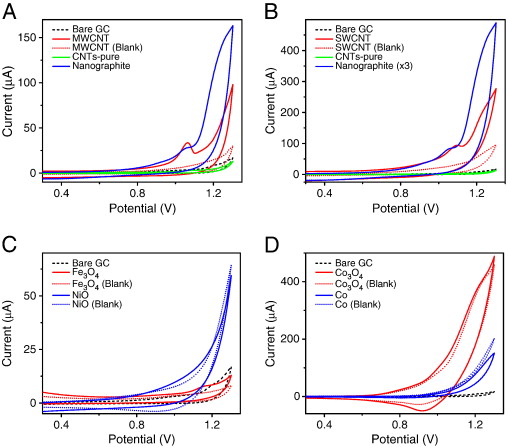
Carbon nanotubes can exhibit negative effects in electroanalysis due to presence of nanographite impurities

Carbon nanotubes are widely used in electroanalysis. There is a significant interest in the determination of dopamine in the presence of its interference, ascorbic acid. It has been claimed that CNTs modified electrodes can solve this analytical problem as the oxidation of ascorbic acid at their surfaces occurs at a significantly lower potential than the …

Carbon nanotubes can exhibit negative effects in electroanalysis due to presence of nanographite impurities Read More »

Direct Determination of Bioavailable Molybdenum in Carbon Nanotubes

Bioavailable residual metallic impurities within carbon nanotubes (CNTs) are responsible for the toxicity of CNTs. Herein we present a method for fast, sensitive determination of bioavailable molybdenum residual catalyst impurities within CNTs by using electrochemical oxidation in neutral pH buffers at low potentials. This method is unique because no other method can rapidly distinguish between …

Direct Determination of Bioavailable Molybdenum in Carbon Nanotubes Read More »

Metallic Impurities within Residual Catalyst Metallic Nanoparticles Are in Some Cases Responsible for “Electrocatalytic” Effect of Carbon Nanotubes

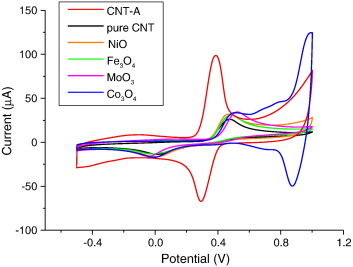
We show that in some cases, the metallic impurities within residual catalyst metallic nanoparticle impurities, which remain in carbon nanotubes from their synthesis even after purification, are responsible for “electrocatalytic” properties of carbon nanotubes. Ibis is demonstrated in an example of double-walled carbon nanotubes (DWCNTs) containing cobalt residual catalyst nanoparticle impurities, which themselves contain iron-based …

Metallic Impurities within Residual Catalyst Metallic Nanoparticles Are in Some Cases Responsible for “Electrocatalytic” Effect of Carbon Nanotubes Read More »