Keyword Author: electron transfer

3D Printed Graphene Electrodes’ Electrochemical Activation

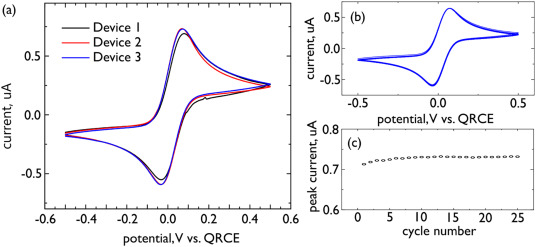
Three-dimensional (3D) printing technologies are emerging as an important tool for the manufacturing of electrodes for various electrochemistry applications. It has been previously shown that metal 3D electrodes, modified with metal oxides, are excellent catalysts for various electrochemical energy and sensing applications. However, the metal 3D printing process, also known as selective laser melting, is …

3D Printed Graphene Electrodes’ Electrochemical Activation Read More »
Layered Noble Metal Dichalcogenides: Tailoring Electrochemical and Catalytic Properties

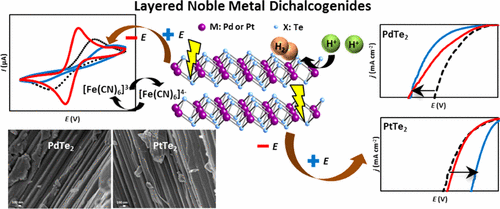
Owing to the anisotropic nature, layered transition metal dichalcogenides (TMDs) have captured tremendous attention for their promising uses in a plethora of applications. Currently, bulk of the research is centered on Group 6 TMDs. Layered noble metal dichalcogenides, in particular the noble metal tellurides, belong to a subset of Group 10 TMDs, wherein the transition …

Layered Noble Metal Dichalcogenides: Tailoring Electrochemical and Catalytic Properties Read More »

Electrochemical catalysis at low dimensional carbons: Graphene, carbon nanotubes and beyond – A review

Nanocarbons, such as graphene, carbon nanotubes and other carbon nanomaterials show very interesting and useful electrochemical and electrocatalytic properties. These can be harnessed in various applications, from sensing and biosensing devices to energy storage and generation devices, such as supercapacitors, batteries or catalysts in the fuel cells. Here we review progress made towards understanding the …

Electrochemical catalysis at low dimensional carbons: Graphene, carbon nanotubes and beyond – A review Read More »

Hydrogenated Graphenes by Birch Reduction: Influence of Electron and Proton Sources on Hydrogenation Efficiency, Magnetism, and Electrochemistry

Interest in chemical functionalisation of graphenes today is largely driven by associated changes to its physical and material properties. Functionalisation with hydrogen was employed to obtain hydrogenated graphenes (also termed graphane if fully hydrogenated), which exhibited properties including fluorescence, magnetism and a tuneable band gap. Although the classical Birch reduction has been employed for hydrogenation …

Hydrogenated Graphenes by Birch Reduction: Influence of Electron and Proton Sources on Hydrogenation Efficiency, Magnetism, and Electrochemistry Read More »

Fluorographites (CFx)(n) Exhibit Improved Heterogeneous Electron-Transfer Rates with Increasing Level of Fluorination: Towards the Sensing of Biomolecules

Halogenated sp(2) materials are of high interest owing to their important electronic and electrochemical properties. Although methods for graphite and graphene fluorination have been extensively researched, the fundamental electrochemical properties of fluorinated graphite are not well established. In this paper, the electrochemistry of three fluorographite materials of different carbon-to-fluorine ratio were studied: (CF0.33)(n), (CF0.47)(n), and …

Fluorographites (CFx)(n) Exhibit Improved Heterogeneous Electron-Transfer Rates with Increasing Level of Fluorination: Towards the Sensing of Biomolecules Read More »

Redox reaction of p-aminophenol at carbon nanotube electrodes is accelerated by carbonaceous impurities

We show here that the enhanced electrochemical behaviour of carbon nanotubes towards the redox reactions of p-aminophenol does not stem from the innate properties of carbon nanotubes. Investigating the isolated effect of each component present within carbon nanotubes samples, which are the carbon nanotube, the graphitic and amorphous carbonaceous impurities and the metallic impurities, we …

Redox reaction of p-aminophenol at carbon nanotube electrodes is accelerated by carbonaceous impurities Read More »

Precise Tuning of Surface Composition and Electron-Transfer Properties of Graphene Oxide Films through Electroreduction

Graphene materials are generally prepared from the exfoliation of graphite oxide (GO) to graphene oxide, followed by subsequent chemical or thermal reduction. These methods, although efficient in removing most of the oxygen functionalities from the GO material, lack control over the extent of the reduction process. We demonstrate here an electrochemical reduction procedure that not …

Precise Tuning of Surface Composition and Electron-Transfer Properties of Graphene Oxide Films through Electroreduction Read More »

Surfactants show both large positive and negative effects on observed electron transfer rates at thermally reduced graphenes

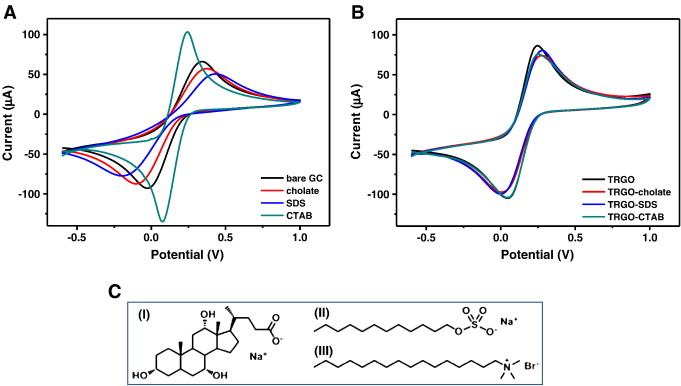
The use of surfactants is ubiquitous in the production of graphene and its analogs as well as their stabilization in solution due to their hydrophobicity causing significant aggregation in aqueous media. Several redox probes ([Fe(CN)(6)](4-/3-), [Ru(NH3)(6)](2+/3+), Fe-aq(2+/3+)) were employed to assess the effect of various surfactants on the electrochemical responses of glassy carbon (GC) as …

Surfactants show both large positive and negative effects on observed electron transfer rates at thermally reduced graphenes Read More »

Nanoporous Carbon Materials for Electrochemical Sensing

Nanoporous carbon materials are highly important materials for a wide array of applications. Here we show that nanoporous carbon can act as highly active materials for electrochemical sensing. We observed that nanoporous carbon material exhibits a faster heterogeneous electron transfer than graphite and pure carbon nanotubes. Nanoporous carbon exhibits a superior electrochemical performance for sensing …

Nanoporous Carbon Materials for Electrochemical Sensing Read More »

Effects of heterogeneous electron-transfer rate on the resolution of electrophoretic separations based on microfluidics with end-column electrochemical detection

We demonstrate here that the electrode kinetics of an electrochemical detector contributes greatly to the resolution of the analyte bands in microchip electrophoresis systems with amperometric detection. The separation performance in terms of resolution and theoretical plate number can be improved and tailored by selecting or modifying the working electrode and/or by controlling the detection …

Effects of heterogeneous electron-transfer rate on the resolution of electrophoretic separations based on microfluidics with end-column electrochemical detection Read More »

Electrochemistry of Graphene: New Horizons for Sensing and Energy Storage

Graphene is a new 2D nanomaterial with outstanding material, physical, chemical, and electrochemical properties. In this review, we first discuss the methods of preparing graphene sheers and their chemistry. Following that, the fundamental reasons governing the electrochemistry of graphene are meaningfully described Graphene is all excellent. electrode material with the advantages of conductivity and electrochemistry …

Electrochemistry of Graphene: New Horizons for Sensing and Energy Storage Read More »

Relationship between Carbon Nanotube Structure and Electrochemical Behavior: Heterogeneous Electron Transfer at Electrochemically Activated Carbon Nanotubes

The electrochemical activation of multiwalled carbon nanotubes (MWCNTs) (at potentials of 1.5-2.0 V vs Ag/AgCl for 60-360 s) results in significantly increased rate constants (k(obs)(0)) for heterogeneous electron-transfer with [Fe(CN)(6)](3-14-) (from 8.34 x 10(-5)cms(-1) for as-received MWCNTs to 3.67 x 10(-3) cm s(-1) for MWCNTs that were electrochemically activated at 2.0 V for 180s). The …

Relationship between Carbon Nanotube Structure and Electrochemical Behavior: Heterogeneous Electron Transfer at Electrochemically Activated Carbon Nanotubes Read More »