Keyword Author: electroanalysis

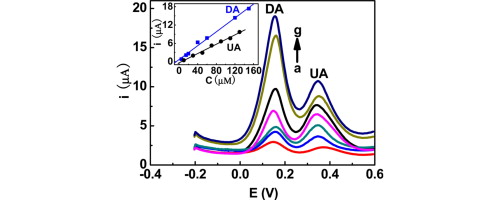
Boron and Nitrogen Doped Graphene via Microwave Exfoliation for Simultaneous Electrochemical Detection of Ascorbic Acid, Dopamine and Uric Acid

Boron and nitrogen doped graphenes show opposite effect on the electronic structure, one with electron withdrawing and another one with electron donating effects. It is of high importance to investigate the influence of B or N doping on biomarkers detection and compare it to non-doped graphene. Here we show that B-doped graphene shows significant enhancement …
Boron and Nitrogen Doped Graphene via Microwave Exfoliation for Simultaneous Electrochemical Detection of Ascorbic Acid, Dopamine and Uric Acid Read More »

Simultaneous Direct Voltammetric Determination of Metal-Oxide Nanoparticles from Their Mixture (CuO/NiO)

Metallic oxide nanoparticles are increasingly being incorporated into consumer products, posing health hazards and damage to the ecology when they are released into the environment. In view of this situation, the development of highly sensitive and facile methods for the detection and quantification of harmful metallic oxide nanoparticles present in a sample is necessary. In …

Simultaneous Direct Voltammetric Determination of Metal-Oxide Nanoparticles from Their Mixture (CuO/NiO) Read More »

Carbon nanotubes can exhibit negative effects in electroanalysis due to presence of nanographite impurities

Carbon nanotubes are widely used in electroanalysis. There is a significant interest in the determination of dopamine in the presence of its interference, ascorbic acid. It has been claimed that CNTs modified electrodes can solve this analytical problem as the oxidation of ascorbic acid at their surfaces occurs at a significantly lower potential than the …

Carbon nanotubes can exhibit negative effects in electroanalysis due to presence of nanographite impurities Read More »

Electroanalytical parameters of carbon nanotubes are inferior with respect to well defined surfaces of glassy carbon and EPPG

This paper reports on the electroanalytical parameters of single – (SWCNT), double – (DWCNT) and multi-walled carbon nanotubes (MWCNT) compared with the standard, well defined surfaces of glassy carbon (GC) and edge-plane pyrolytic graphite (EPPG) electrodes. Such parameters include repeatability, sensitivity and linearity of the analytical response, and selectivity of the materials using differential pulse …

Electroanalytical parameters of carbon nanotubes are inferior with respect to well defined surfaces of glassy carbon and EPPG Read More »

Molybdenum metallic nanoparticle detection via differential pulse voltammetry

Direct electrochemical detection of nanoparticles is of high importance of analytical chemistry and nanotechnology. We show here that molybdenum nanoparticles are readily oxidizable in phosphate buffer of neutral pH at -5 mV (vs. Ag/AgCl). This open doors for direct detection of molybdenum with important implications for the use molybdenum nanoparticles as labels in electrochemical biosensors. …

Molybdenum metallic nanoparticle detection via differential pulse voltammetry Read More »