Keyword Author: Biosensors

(Bio)Analytical chemistry enabled by 3D printing: Sensors and biosensors

3D printing has revolutionized the concept of object manufacturing, making an enormous impact on industry and economy. The technology has found a niche in countless fields, including scientific research. It has rendered practical solutions to scientific problems by offering tailored-shaped devices with exquisite control in design and geometry and through the versatility of printable materials. …

(Bio)Analytical chemistry enabled by 3D printing: Sensors and biosensors Read More »
Mycotoxin Aptasensing Amplification by using Inherently Electroactive Graphene-Oxide Nanoplatelet Labels

We develop an electrochemical aptasensor for ochratoxinA (OTA) by utilizing graphene-oxide nanoplatelets (GONPs) as electroactive labels. OTA aptamer (OTA-apt), which serves as the recognition element, was first immobilized onto the electrode surface before the modified electrode underwent exposure to OTA. Subsequently, incubation with GONPs was performed and the nanoplatelets conjugated to the immobilized OTA-apt through …

Mycotoxin Aptasensing Amplification by using Inherently Electroactive Graphene-Oxide Nanoplatelet Labels Read More »

Rational Design of Carboxyl Groups Perpendicularly Attached to a Graphene Sheet: A Platform for Enhanced Biosensing Applications

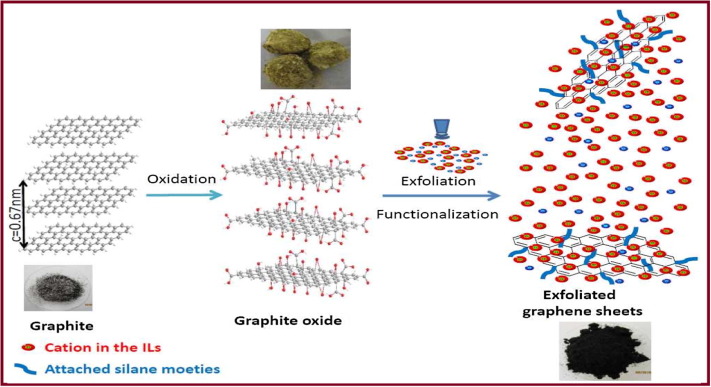
Graphene oxide (GO)-based materials offer great potential for biofunctionalization with applications ranging from biosensing to drug delivery. Such biofunctionalization utilizes specific functional groups, typically a carboxyl moiety, as anchoring points for biomolecule. However, due to the fact that the exact chemical structure of GO is still largely unknown and poorly defined (it was postulated to …

Rational Design of Carboxyl Groups Perpendicularly Attached to a Graphene Sheet: A Platform for Enhanced Biosensing Applications Read More »

Biorecognition on Graphene: Physical, Covalent, and Affinity Immobilization Methods Exhibiting Dramatic Differences

The preparation of biorecognition layers on the surface of a sensing platform is a very crucial step for the development of sensitive and selective biosensors. Different protocols have been used thus far for the immobilization of biomolecules onto various electrode surfaces. In this work, we investigate how the protocol followed for the immobilization of a …

Biorecognition on Graphene: Physical, Covalent, and Affinity Immobilization Methods Exhibiting Dramatic Differences Read More »

Graphenes Prepared by Hummers, Staudenmaier and Hofmann Methods for Analysis of TNT-Based Nitroaromatic Explosives in Seawater

The detection of TNT and related nitroaromatic compounds in seawater is of great interest. Electrochemical techniques can be applied for detection purposes since nitroaromatic compounds contain easily reducible nitro groups. In this study, we investigate the performance of thermally reduced graphenes prepared by three different oxidative methods: Hummers, Staudenmaier and Hofmann methods with consequent thermal …

Graphenes Prepared by Hummers, Staudenmaier and Hofmann Methods for Analysis of TNT-Based Nitroaromatic Explosives in Seawater Read More »

Nucleic Acid Functionalized Graphene for Biosensing

There is immense demand for complex nanoarchitectures based on graphene nanostructures in the fields of biosensing or nanoelectronics. DNA molecules represent the most versatile and programmable recognition element and can provide a unique massive parallel assembly strategy with graphene nanomaterials. Here we demonstrate a facile strategy for covalent linking of single stranded DNA (ssDNA) to …

Nucleic Acid Functionalized Graphene for Biosensing Read More »

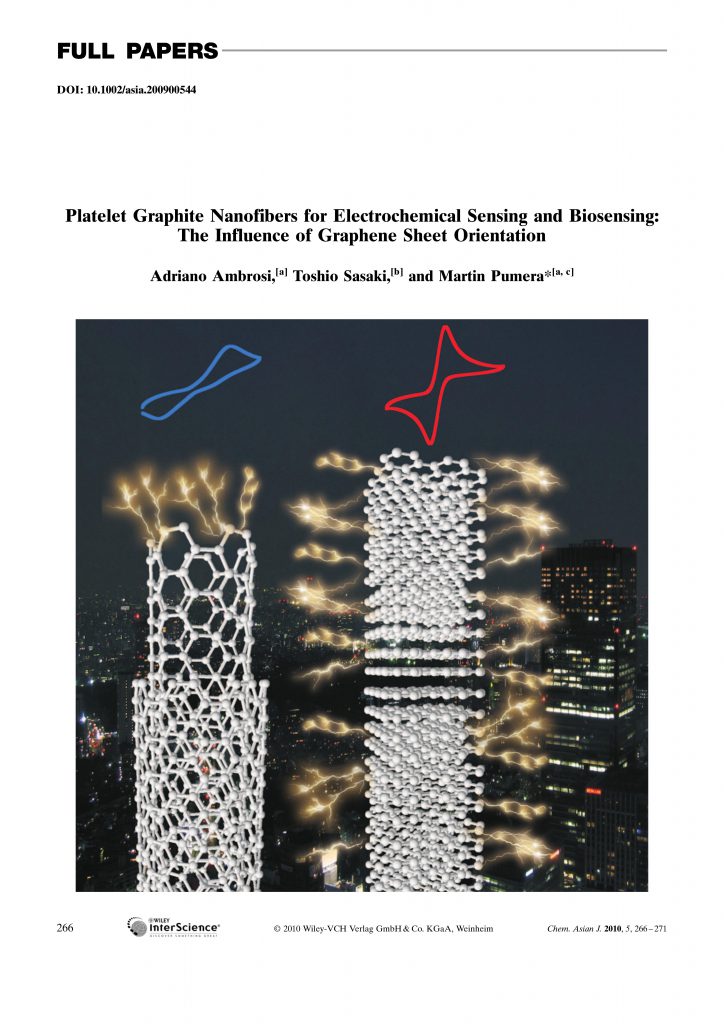
Platelet Graphite Nanofibers for Electrochemical Sensing and Biosensing: The Influence of Graphene Sheet Orientation

Here, we demonstrate that platelet graphite nanofibers (PGNFs) exhibit fast heterogeneous electron-transfer rates for a wide variety of compounds such as FeCl3, ferrocyanide, dopamine, uric acid, ascorbic acid, and the reduced form of beta-nicotinamide adenine dinucleotide. The electrochemical properties of PGNFs are superior to those of multiwalled carbon nanotubes (MWCNTs) or graphite microparticles (GMPs). Transmission …

Platelet Graphite Nanofibers for Electrochemical Sensing and Biosensing: The Influence of Graphene Sheet Orientation Read More »

Electrochemical nanobiosensors

This review discusses main techniques and methods which use nanoscale materials for construction of electrochemical biosensors. Described approaches include nanotube and nanoparticle-based electrodes relying on aligned nanotube arrays, direct electron transfer between biomolecule and electrode. novel binding materials and mass production technology; and nanoscale materials as biomolecule tracers, including gold nanoparticles, quantum dots for DNA …

Electrochemical nanobiosensors Read More »