Keyword Author: amino acids
Microfluidics in amino acid analysis
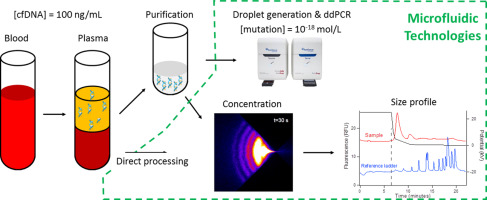
Microfluidic devices have been widely used to derivatize, separate, and detect amino acids employing many different strategies. Virtually zero-dead volume interconnections and fast mass transfer in small volume microchannels enable dramatic increases in on-chip derivatization reaction speed, while only minute amounts of sample and reagent are needed. Due to short channel path, fast subsecond separations …
Microchip separation and electrochemical detection of amino acids and peptides following precolumn derivatization with naphthalene-2,3-dicarboxyaldehyde
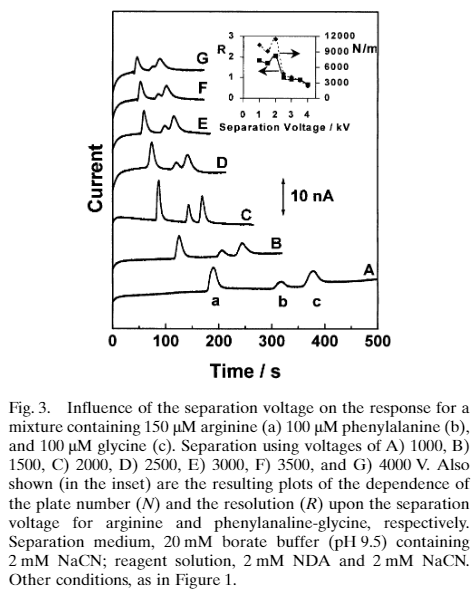
An integrated microfluidic device is used to derivatize, separate, and amperometrically detect amino acids and peptides in the presence of naphthalene-2,3-dicarboxyaldehyde (NDA). The integrated system offers a rapid (4 min) simultaneous measurements of 5 amino acids (Arg, Lys, Gly, Cys, PhenA) down to the 3.2 muM level in connection to a precolumn reaction chamber, an …
Chiral analysis of biogenic DL-amino acids derivatized by urethane – protected alpha-amino acid N-carboxyanhydride using capillary zone electrophoresis and micellar electrokinetic chromatography
A new analytical method for enantioselective separation of DL-amino acids derivatized by N-fluorenylmethoxycarbonyl-L-alanyl N-carboxyanhydride (FMOC-L-Ala-NCA) using capillary electrophoresis was developed. Separation parameters, such as composition and pH of the background electrolyte, and concentration of gamma-cyclodextrin (in capillary zone electrophoresis) and sodium dodecyl sulfate (in micellar electrokinetic chromatography) were optimized. The separation method was validated and …